A Tool for Accountability: How Community Development Agreements Can Empower Uganda's Mining Host Communities.

By Judith Nansubuga, 2026 Bertha Challenge Fellow
Uganda's mining sector is expanding very fast. New licenses are issued, new investors arrive, and new deals are struck in rooms the affected communities never enter. Government and investors negotiate the terms. Primary Host communities watch gold and other minerals leave their land for foreign markets while living with the environmental, social and economic costs of extraction, often with no clear route to redress.
Under Section 3 of Uganda's Mining and Minerals Act, a "primary host community" is defined as a single community of persons mutually agreed upon by the holder of a large-scale, medium-scale, or small-scale mining licence and the local government where the mining area is located. In practice, these are the ordinary people living closest to the pits, the tailings and the haul trucks of the mining projects.
Where no community resides within thirty kilometres of the mining area's boundary, the local government itself stands in as the primary host community. This raises an uncomfortable but necessary question: do mining host communities have a voice in decisions that reshape their land, their livelihoods and their future?
Over the past several months, working with the Mawero Mining Host Community in Busia District as a fellow of the 2026 Bertha Challenge fellowship programme, I have seen the answer up close. In practice, communities have had very little real capacity to influence how mineral wealth is managed and governed around them, not because the law shuts them out but because the tools that could give them a seat at the table are poorly understood and rarely used to their full potential.
What a CDA Is?
A Community Development Agreement (CDA) is not a courtesy gesture or a corporate social responsibility add-on. It is a legally binding agreement between a mining company and the communities affected by its operations, setting out concrete commitments on development, benefit-sharing and how the impacts of mining will be addressed.
Sections 227 and 228 of the Mining and Minerals Act 159 require every mineral rights holder to negotiate a CDA with affected communities but it lacks the machinery to apply it: regulations to guide how CDAs are negotiated and monitored, and a standard template that sets out clear terms for both company and community to work from, rather than leaving each agreement to be built from scratch, often to the advantage of whichever side has more resources and experience at the table.
For a host community, a CDA is more than legal compliance, it is a framework for the entire relationship between company and community, and that makes it a genuine accountability tool. A meaningful CDA should therefore address the following:
- Land access and fair compensation.
- Benefit-sharing and payments.
- Local employment and skills development.
- Environmental and cultural protection.
- Community governance and representation.
- Environmental mitigation and adaptation.
- Grievance and dispute resolution.
- Mine closure and transition planning.
These are not soft "development" add-ons. They are corporate accountability issues, and they only carry weight when they are written into a CDA as clear and enforceable commitments rather than left as informal promises.
What I Learned in Mawero.
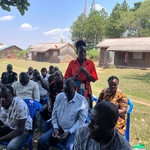
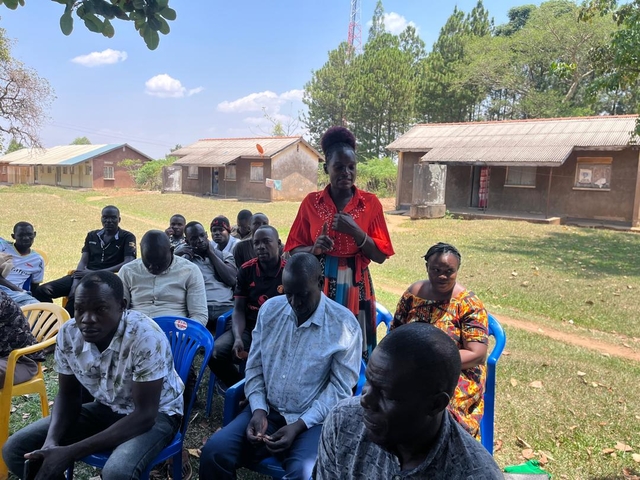
During this fellowship year, I have worked with members of the Mawero Mining Host Community to help them understand the purpose of a CDA, articulate and identify their own priorities, and engage meaningfully in negotiating their agreement with Wagagai Mining (U) Ltd.
This work mattered because the community's concerns go well beyond corporate social responsibility. The CDA gave us a way to translate those concerns: human resource development, infrastructure, protection of natural resources, among others into commitments that can be tracked and enforced.
Working alongside the Mawero Mining Host Community Welfare Association, a community-based organisation that advocates for the rights of the Mawero Mining Host Community, our focus was building the community's capacity to do more than merely understanding what a CDA is on paper but to interrogate the processes, identify priorities and challenge any unfair processes.
This involved moving beyond a theoretical understanding of the agreement to critically examining the processes, identifying local priorities, and challenging practices that may be unfair or undermine community interests. Ultimately, we wanted residents to reflect on what the CDA should mean for them and what accountability from the mining company should look like in practice. Mawero is now finalising its CDA. What has changed is that community members are far better equipped to sit in negotiations, scrutinise the commitments on the table and push for an agreement that genuinely reflects their interests, not simply accept whatever is proposed.
The CDA as a Compass.
Whereas a mining company needs predictability to operate, a host community needs assurance that mining will bring development without eroding its rights, livelihoods and environment. A well-negotiated CDA bridges these two needs as it gives direction to the relationship for the life of the mining project, and it gives both sides a basis for monitoring whether commitments are kept.
But a CDA is only as strong as the community's capacity to negotiate it. Left alone, it can become a document that simply records what a company is willing to offer. What Mawero shows is the alternative: when a community understands its rights and negotiates from that position, the CDA becomes a tool that puts them in the room, not just on the sidelines.
That shift doesn't happen on its own, and it shouldn't depend on which community happens to have outside support. Mawero got there because my fellowship year happened to bring in the right support at the right time. Every host community in Uganda deserves that same opportunity without needing that kind of luck. Regulations and a model CDA template would not replace a community's voice but give it a foundation to stand on. That is what empowerment through accountability looks like, not communities waiting to be given a fair deal, but communities equipped to negotiate one for themselves.
This blog post was produced as part of the 2026 Bertha Challenge Fellowship.

Greenwatch
We believe that environmental rights can be better exercised when people have access to information, can participate in decisions that affect their surroundings and have access to justice incase their rights are violated. Greenwatch exists to ensure that every individual in Uganda knows that they have environmental rights and these rights can be fully exercised through access to information, justice and public participation.